





less than 12 months, 1000’s of brands have jumped into AI Search. Prompted by Boards, their bosses and billions of people now using Large Language Models (LLMs) like ChatGPT and Gemini, “wait and see” turned into “measure and learn.” Brands are beginning to discover, however, that profitable AI Search requires more than a dashboard.
Success in AI Search goes far beyond the Brand’s website. As this learning becomes pervasive, expect a blood bath for AI Search companies only offering dashboards, one example of mounting investor expectations for an AI ROI after trillions in commitments.
Applying Topic Intelligence for the Brand website GEO
For sure, a Brand focusing on its own website to improve its AI Search visibility is a critical foundation. The changes needed in Generative Engine Optimization (GEO) however, often extend far beyond SEO.
In GEO, a brand’s website takes on added importance as a source of canonical product information, claims control, and signal consistency. While website schemas can make crawling a website easier, signal inconsistency (e.g, product taxonomy, claims, etc) within the website can materially undermine LLMs using URLs from a Brand website as the source of canonical truth.
Brands as the source of truth for their own product line is a missed opportunity. At XEO360, we’ve found through recurring audits of the citation sources LLMs use to make recommendations, that the most important topics across the brand’s category can be harnessed for greater AI Search visibility.
In energy drinks, that could be caffeine safety. In the drugstore cosmetics category, that could be serum solutions. In hair repair that could be hair bonding. Extending this “Topic Intelligence” across Reddit, YouTube, Publishers, and Amazon reviews provides the brand with crucial topics, keywords and queries to inform their recurring brand website content calendar.
This presents opportunities for any Brand to materially increase the % Share of Voice (SOV) of its website by creating category-relevant topic or keyword content through blogs, how-to Guides, listicles, and FAQs, complemented wherever possible by clinical evidence.
The Truth: Brand websites drive only 3% of LLM visibility in citation sources
After XEO360 aggregating every LLM response across our August 2025 — January 2026 query runs, the brand’s website now only accounts for 3% of all citation sources on ChatGPT for US and UK. On Gemini, this number drops to 2% and on Perplexity, its closer to 1%. These numbers differ materially by funnel stage. With Awareness stage consumer queries, its 1% while for Decision stage, this rises to 4%, underlining the later funnel stage canonical truth LLMs seek from brand websites.
This speaks to 2 inconvenient truths. Firstly, brands are typically missing a huge opportunity to own the broader category conversation by creating topic relevant content at the top of the funnel. Secondly, that although a brand website is a crucial source of truth, across all LLMs, up to 99% of all citation sources are NOT from the brand’s own website.
Press enter or click to view image in full size
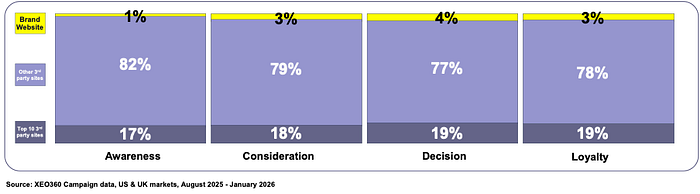
Fig 1: LLM Citation Source % Breakout by Funnel Stage — Aggregation across ChatGPT, Gemini & Perplexity
Why Brand websites alone won’t cut it
LLMs privilege independent validation, repetition across domains, and comparative framing when deciding what information to surface and cite. Like vetting resumes for a job, only a tiny % make it through. A claim that appears only on a brand website — no matter how well written, structured, or schema-marked — is treated as self-asserted. The same claim, repeated across Reddit threads, YouTube reviews, publisher articles, retailer PDPs, and comparative listicles, is treated as corroborated.
This is not accidental. LLMs are trained to infer trust from signal convergence: when multiple unrelated sources independently reinforce the same attributes, benefits, or cautions, confidence rises. When information exists in isolation — even if it is accurate — LLM confidence is fractional.
This isn’t a failure of Brand websites; it’s a function of how LLMs evaluate trust. Brand websites are structurally disadvantaged because they are single-party sources with no (brand) comparative context. They can excel at canonical truth, specification accuracy, and claim ownership, but they typically underperform at the exact signals LLMs reward most: third-party validation and cross-source repetition.
Get Jason Forbes’s stories in your inbox
Join Medium for free to get updates from this writer.
Subscribe
This is why optimising the brand website is necessary but insufficient. Profitable AI Search requires brands to deliberately engineer distributed credibility — ensuring that the same category-defining truths exist, consistently and independently, across the wider ecosystem that LLMs actually learn from and cite.
Making AI Search profitable for your Brand
Prioritizing the sources driving LLM citations is the first step your Brand should take.
These vary materially across different LLMs and across different verticals (e.g, Beauty vs Food & Beverage). They also vary by market. Below, for an XEO360 Beauty client, is an example of the top 10 sources per LLM for the US, underlining the diversity that exists:
Press enter or click to view image in full size

Fig 2: LLM Citation Source % Breakout within the Top 10
The good news? The top 10 sources can account for up to 45% of all citations, meaning raising your Brand’s visibility on these will have a disproportionate impact.
Further, for CPG in particular, many of these sources, including Reddit, YouTube, Wikipedia, Amazon, Walmart, and yes, your own Brand website, can be directly or indirectly influenced by actions you can take. In fact, for some brands, they’ve already been able to lift % citation sources from their website far above the 3% average.
Pushback from early Brand adopters of vanilla AI Search dashboards includes the following:
- Action — “Don’t just give me an AI Search dashboard, show me what specific actions to take.”
- Automation — “There’s no way my team can execute across these actions.”
- Attribution — “Without measurement, there is no business case.”
So, where does your Brand sit on its AI Search journey?
Over the next series of posts, I’ll be unpacking these areas with rich examples of early Brand successes and failures. This space is moving fast; for example, in just the past 90 days, Amazon has dropped out of the top 10 citation sources for many Brands on ChatGPT, reflecting site accessibility changes: http://bit.ly/3LmEAhb.
I’d love to hear from you if you’re keen to explore AI Search profitability or, even better, share your learnings.
For sure, it’s going to be a wild ride in 2026.

This story is published on Generative AI. Connect with us on LinkedIn and follow Zeniteq to stay in the loop with the latest AI stories.
Subscribe to our newsletter and YouTube channel to stay updated with the latest news and updates on generative AI. Let’s shape the future of AI together!